Educating Toddler about safety
Educating toddlers about safety attains great importance and toddlers need to be educated by parents regarding safety at home, on the driveway and in dealing with strangers, and people known to them. This will enable toddlers to live safely in this world of danger and uncertainty.
Safety begins at home and mothers should be encouraged to not only take steps to ensure safety at home, but to also educate their children especially toddlers. Parents should rate the rooms and child safety products; a survey showed that most parents thought the kitchen was the most dangerous room, while the stair gate was the most important child safety product.
It is futile to assume that most accidents can be prevented by child-proofing the home as new dangers develop as the child grows. The solution lies in educating the children from a young age about the hazards and how to deal with them. Home safety lies in safety equipments like safety gates and fireguards and child proof blind cords; ensure that the corded-blind have short cords that are out of reach of children by using many cleats, cord tidies, clips or ties.
Another area of safety that toddlers as well as adults need to be educated is safety in driveways; a frightening number of children are killed each year on their very own driveways, often by their own parent who is reversing and simply hasn’t seen them.

Here are a few tips for driveway safety for both toddlers and parents:
• Children especially toddlers should be educated to not play in and around parked vehicles; they should also be made aware of the risk of running to greet or wave goodbye to visitors while the vehicles are still maneuvering.
• Parents and toddlers need to be educated that drivers of large vehicles are not able to see small children who are close to the vehicle’s bumpers. Also children need to be educated that car drivers have limited view of children in the mirror while reversing off a driveway. It would be best for the driver to reverse onto the driveway and then drive forward.
• It would help for the car driver to be aware of one’s surroundings by winding down the windows and being mindful of blind spots; they should be slow while reversing.
• In the interest of the children, drivers should always park in gear on a slope and turn the wheel; even if it moved it would stop at a kerb.
• Last but most important, parents need to take precautions by checking well before reversing, keeping parked cars locked, and talking to your children about practical safety about cars.
Parents need to be conscious to the dangers that could come to children even when dealing with people known to them or strangers. Parents need to be aware that even people known to the children can cause them harm; children need to be educated about safety rules in dealing with strangers as well as known people and how to set boundaries.
Skills and knowledge, with simple and effective ways would keep the children safe; the method of education has to be one that does not scare the children. Children need to understand that there are different safety rules when they are in the care of an adult and when they are on their own. They need to know what to do in the absence of an adult.
Some tips of teaching children safety with strangers:
• Never preach to a child that a stranger is bad; instead focus on teaching children about practicing the skills and behavior to be safe. Tell your kid in a matter-of –fact way that most strangers are good, but they have a problem and harm children.
• If an adult is around they need to check with him/her before getting too close or talking to the stranger. Encourage kids to come out with examples of people they know and those they don’t. The adult in charge should be told where the kid is going, with whom and what he/she will be doing.
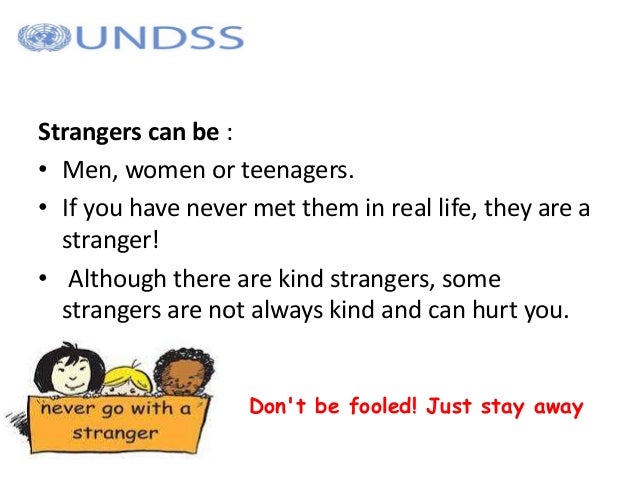
• In case kids are on their own, but could seek the help of an adult they should seek their help. In case the kid is on his/her own and old enough he/she should be encouraged to be around with other people whom they can seek help in case of need. No personal information is to be told to a stranger or anyone the kid is not comfortable with.
• The kid should know the family’s safety rules for answering the door, being on the phone, and being on the internet.
Some tips of teaching children safety with people they know:
• Children need to be told that nobody should touch their body for play, teasing or affection without their permission; this mainly applies to private parts that should not be touched for any other reason except health. The same applies to someone else asking the kid to touch their private parts.
• The touch or any other behavior for safety or health should never be a secret; also anything that bothers them should ever be a secret to the adult.
• The child should be made to understand that anything said by others should not bother them and they should trust that they have an adult to help them in case there is a problem.
All this goes to educating toddlers about safety.
Take the next step toward your goals
Share your requirement and find the best care providers in your area
-
Looking for a caretaker’s job? Build your profile and get in touch with families in your vicinity.
-
Discover nannies, babysitters, cooks, housekeepers, pet sitters, and elder care under one roof.
-
Get all the support you need to run a successful care center.
-
Search for appropriate centers near you depending on your needs.
Care Corner Insights: Blog Library
From Daycare to “Village Care”: How Indian Families in the US Are Redefining Childcare
From Daycare to “Village Care”: How Indian Families in the US Are Redefining Childcare For many Indian families in the US and Canada, childcare has become one of the biggest everyday challenges. With fewer extended family members

Best After-School Care Options for Working Parents
The school bell rings at 3 PM. Your workday ends at 6 PM. Sound familiar? For many working parents, the hours between school dismissal and the end of the workday can feel like a daily puzzle. Balancing meetings, deadlines, commutes, and parenting re

Reducing First-Day School Anxiety: A Parent’s Guide to a Smooth Transition
The first day of school is a milestone—for both kids and parents! But let’s be honest: it can also be a whirlwind of emotions. Excitement, curiosity, and yes, a fair share of anxiety. Whether your little one is starting kindergarten or your teen is s

Lunch Box Ideas for Busy NRI Parents: Quick, Healthy, and Kid-Approved!
Mornings are chaotic. Lunchboxes don’t have to be. Let’s be real—between rushing to get the kids dressed, finishing breakfast, and hunting for that one missing shoe, packing lunch can feel like a daily battle. And when you’re an NRI parent, there’s
Helping Kids Transition from Summer to School Routines
The Summer-to-School Struggle Is Real - Because Back-to-School Doesn’t Have to Be Back-to-Stress! Summer is all about late mornings, endless playtime, and zero routines. But when September rolls around, reality hits—early alarms, homework, and stru

Back-to-School Readiness Checklist for Preschoolers
Summer has a funny way of making children forget that routines exist. Late breakfasts, relaxed bedtimes, endless playtime, summer camps, family outings, and plenty of screen-free fun can make the season memorable. But as summer winds down and prescho

How Daycare Centers Can Increase Enrollment During Summer: 7 Proven Strategies for 2026
Summer is HERE! And while kids are screaming for vacation, parents are scrambling for trusted daycare. For Daycare Centers, Montessori Schools, Preschools, and Play Schools — Summer is NOT a slow season, it's your GOLDEN season! Did you know parents

How a Housekeeper Can Help During School Holidays: Reclaim Your Sanity (and Your Free Time!)
The School Holiday Struggle Is Real "The kids are home, the house is a warzone, and your to-do list is longer than a summer

Benefits of Hiring a Personal Cook During Summer Vacation
“More Fun, Less Stress, and Delicious Meals! - Because Summer Should Be for Relaxing—Not Slaving Over a Hot Stove!" The Summer Dilemma: Vacation or Kitchen Duty?

Summer Safety Checklist for Toddlers and Preschoolers
Summer means park days, sprinklers, and long evenings outdoors—but for toddlers and preschoolers, it also brings extra safety challenges. Little ones can overheat quickly, wander near water, or bump into hazards while they explore. This simple summer